March 02, 2009

Roof Mold Is Actually Roof Algae

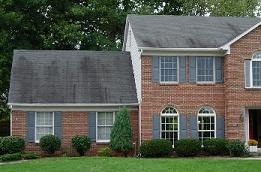
Though those ugly black streaks and stains on your shingles might appear to be some sort of roof mold, a more accurate description would be to call it roof algae.  This is a hardy species of algae called Gloeocapsa Magma, and if you aren't using the right chemicals or methods it can be extremely difficult to remove.  Call it roof mold, roof algae, roof mildew, or whatever else you want, but just be sure to clean it off in a timely and safe manner.

Just to be thorough, there are other types of organic growth that can form on a roof other than roof algae (or mold).  There's also the possibility of lichen or moss growth.  Lichen is usually a whitish color, but it can also have tones of green, yellow, and brown.  It often forms in patches of individual circles, each averaging about the size of a dime.  It's also noticeably raised from the surface, unlike the black algae stains.

Moss, on the other hand, almost always has a green color and if left untreated for several years will become so thick as to be noticeable from the ground.  I've seen some situations where it's been ignored for so long that it literally looks like a roof is covered with green carpet.  Honestly I don't know what people are thinking when they allow this to happen to their home.

So how does one go about treating a roof with lichen and/or moss?  Well, in most cases it should be handled in the same manner as the black algae roof stains (or "roof mold"), which has already been described in length on this site.  In a nutshell, a bleach or chlorine-based solution applied with non-pressure methods will kill lichen and moderate moss growth almost instantly.  It should turn a whitish color within minutes, which tells you that it's dead.  Unlike black algae stains which come off immediately with the rinse phase of the cleaning, dead lichen and moss will require a few heavy rains to finish rinsing off the roof.  It could take awhile but rest assured that lichen and most moss situations, once dead, will eventually dislodge and rinse off the roof thanks to mother nature. 

If you are the impatient type and want the lichen and moss removed immediately, you'll have to use a pressure washer, but as you should know by now I highly discourage the use of high pressure on a roof.  In those rare cases where the moss is extremely thick and out of control (this is more common in the northwest) your only choice might be to use a pressure washer, but even in these extreme scenarios you should dial down the pressure and use extreme caution.

In summation, black roof "mold" stains (algae) should come off immediately if using the proper methods.  White or green lichen and moss, on the other hand, will be killed with the same chemicals but will need a few heavy rains to finish rinsing away.

February 06, 2009

Roof Stains Should Be Cleaned Without Scrubbing

In my dealings with potential customers who want their black roof stains removed, I'll sometimes run into someone who thinks the roof should be scrubbed clean with a hard-bristle brush in conjunction with some sort of cleaner.  At first this "method" might seem to make sense, but it's a definite no-no and I'll tell you why.

I can pretty much guarantee that if you try to clean your roof stains with aggressive scrubbing or agitation, you're going to lose a lot of shingle granules in the process.  With enough force these will pop right off of asphalt shingles, which is why I also do not recommend roof cleaning with a power washer.  Granules do more than just add the color to your shingles.  They are vital to your roof's health because they reflect sunlight, thus keeping your attic cooler and your AC bills lower.  If you think your attic is warm now just climb up into one that is covered by a roof that is missing a lot of granules or is covered in black algae stains - you'll probably notice the difference in temperature.  In general, the quicker your roof loses granules the quicker it will lose its integrity, and the quicker you'll need to get a new roof.  So hopefully you can see how important this so-called "shingle grit" actually is.

The other reason you shouldn't be scrubbing or pressure washing your roof is that in most cases it's simply not necessary.  I go into this in a lot more detail throughout this site, but the bottom line is that if your contractor is using the correct chemicals then no surface agitation should be required.  You simply spray on the chemical with the help of a non-pressure pump, allow several minutes for it to kill the algae, and then rinse gently with a garden hose.  The only rare instance where a power washer might be useful is with very thick, green moss, but if all you have are black algae roof stains then you should have no need for scrubbing or power washing.  Make the mistake of cleaning your roof with high-pressure or aggressive agitation and you will probably only shorten its lifespan.  Use the right roof stain remover without pressure and you will extend your roof's lifespan.

January 31, 2009

Roof Cleaners - The Checklist

So you're finally ready to hire some professional roof cleaners.  Your spouse is complaining that the black roof stains are ruining your curb appeal, and after reading through this site you now understand that it's also an issue of your roof's health and longevity.  Now you need to know how to find a roof cleaning company that will do the job right.  Here's a general checklist for what to look for in a contractor that cleans roofs.

  • You would be wise to find a roof cleaning service that uses non-pressure methods for roof stain removal.  If you've been digesting the other reading material on this site you should know by now that high-pressure roof cleaning is generally not a great idea.  The only rare exception could be in situations where there is very thick green moss like a carpet on your roof, and even in this extreme situation the pressure should be used carefully and responsibly.  Educated roof cleaners know that in the vast majority of cases, black roof stains can be completely and safely removed with the gentle application of a bleach or chlorine-based solution followed by a non-pressure rinse.  If you come across a contractor that wants to clean your roof with a high-pressure wand, run in the other direction as fast as possible.
  • Find a roof cleaning service that operates in teams of two on every job.  Theoretically, a roof cleaning could be done with one person, but the ideal scenario would be to have two roof cleaners on site for your job, one to apply the chemical and do the rinsing at the roof level, and the other to remain on the ground for perimeter rinsing and just as a "safety valve" in case the roof-man needs assistance.
  • Roof cleaners that have been in the game for any length of time know that your whole roof should be cleaned, not just the areas where black stains are visible to the naked eye.  If you can see stains in any one area, that's usually an indication that algae is already taking hold over your entire roof and will just require a little more time to become completely visible everywhere.  Best to clean the whole thing and start with a clean slate, so to speak.
  • Ask to make sure that the contractor has liability insurance.  This one's a no-brainer for any home improvement job, of course.  It not only protects you but it helps to weed out the handyman types who probably don't understand the proper methods for roof cleaning to begin with.
  • Though this last one isn't a necessity, you might check to see if the roof cleaner is BBB accredited.  If so, that's usually a good sign that they have been around for awhile and are truly knowledgeable about roof stain removal.  If they aren't a member of the BBB then ask for a few references that can vouch for them.  It's also a good signal if they have their own before and after pictures to show off, either on a website or in a portfolio.

So there you have it.  Follow this list and you should be very happy with the results.  Ignore it at your own risk.  By the way, we have an ever-growing directory of professional roof cleaning services on this site for your convenience.

December 17, 2008

Partial Roof Cleaning Not Recommended

Roof stains usually first appear on the northern-facing areas of a roof surface, as you've no doubt noticed.  This is because these areas receive less sunlight in the Northern Hemisphere (it's the other way around in the Southern Hemisphere, as roof cleaners in Australia could attest to).  Sunlight aids in drying out the southern-facing slopes much more quickly after a rain, and since roof algae growth is accelerated by moisture, you can see how sunlight plays a role.  Direct UV rays from the sun also aid in retarding the growth of algae on these surfaces.

However, it's important to understand that even though the sun helps to slow the growth of algae on southern-facing surfaces, it does not stop it.  If you have stains beginning to develop on the northern-facing surfaces of your roof, it means that it's just a matter of time before the entire roof is covered with algae stains.  You might not yet see black stains on the southern-facing surfaces, but that doesn't mean that algae hasn't already taken root and begun to multiply in these areas.

That's why it's a good idea to have the whole roof surface cleaned, even though it may appear that stains are confined to one side of the roof.  If you can see it somewhere on the roof, that means it's everywhere on the roof.  You can demand that your roof cleaning contractor only cleans the area where you can actually see black stains, but don't be surprised when, 12 months later, that area is still clean but the rest of the roof is suddenly covered in now visible black algae.

November 18, 2008

Roof Cleaning Safety Products For The DIY Enthusiast.

You all should know by now that I discourage DIY roof cleaning because of the hazards involved, but I know that some people will attempt to do it anyway.  So I wanted to throw together just a short list of safety products for roof cleaning that many of the pros use (yes it can get expensive to buy all this stuff but roofs with slippery chemicals on them are a recipe for disaster if precautions aren't taken (don't say I didn't warn you)).

  1. Get some Cougar Paws - amazing traction.  The grip on these shoes is so good you'll feel like spiderman (or a cougar, I suppose).  In fact it is so slip-resistant that it can almost give you a false sense of security.  Wearing good shoes does not mean you can turn your brain off.
  2. Wear jeans or long pants.  No matter what chemicals, products, or procedures you're using some of the stuff is bound to get on you, and better it land on denim than skin.  Of course whatever does get on your skin should be rinsed off immediately.
  3. Wear latex gloves.  Cheap dish gloves from the grocery store will work fine.  Again this will help in keeping chem off your skin.
  4. Wear goggles.  If most of this stuff is bad for your skin just imagine what it can do to your eyes.  If something does splash in your eyes flush them immediately! 
  5. Wear a respirator.  You DO NOT want to get the fumes from this stuff in your lungs.  Trust me.  Make this a priority.  Getting dizzy from exposure 45 feet off the ground is playing with fire, not to mention the potential long-term effects of repeated close-range exposure.
  6. Use a fiberglass ladder if possible to minimize the possibility of electrocution from bumping a power line.
  7. You'd be wise to invest in a roof harness system if you're uncomfortable or unfamiliar with heights, ladders, or roofs in general.  Heck, everyone would be wise to use one.

Sounds like a lot, right?  Why not do yourself a favor and just hire a professional roof cleaning service that already has the equipment and know-how to do it right.  Considering all the chemicals and gear you'd have to buy to do it yourself it would probably be cheaper to hire roof cleaners anyway, so why wouldn't you?  Even if you think that it might save you a few pennies to do it yourself, is it worth it when the potential risks include paralysis or death?  I want to say this one more time to make it perfectly clear:  chemicals or water on a roof will render it EXTREMELY SLIPPERY (think ice), so you better be prepared if you're a hard core DIY guy.

November 14, 2008

Roof Cleaning Products - My Two Cents

People are always asking my opinion of different fad roof cleaning products that they saw in the store or on the internet or wherever, and I always try to patiently explain that there is a safer, more effective way.  Trust me that if there was a way to profitably package and sell a bleach-based roof cleaning solution to the public I believe these companies would do it because they should know it's the safest and most effective method, but there isn't so they don't. 

Instead they've developed these powdered or condensed products that they can manufacture cheaply, ship light for next to nothing, and let you deal with doing all the work (like mixing, renting a power washer, etc.).  They go to great lengths to bash bleach/chlorine based solutions because it's not something that they can profitably sell!  They'll tell you how "green" their product is and how "bad" bleach is but if you do your research (the fact that you're here at this site is a good start) you'll discover that bleach-based roof cleaning is the superior method from both a safety and effectiveness standpoint.  I've cleaned hundreds of roofs with bleach (and ZERO pressure, by the way), and we've never once seen roof, gutter, or house damage as a result.  

On the other hand, I can tell you there's a chance that if you try to use one of those fad products on your roof in conjunction with a pressure washing wand that you'll lose significant numbers of granules from your shingles.  I've seen it first hand where other roof cleaners have taken high pressure to a roof and there are literally hundreds if not thousands of shingle granules on the ground circling the entire perimeter of the house.  This is not good!  They might even tell you that they'll use an extension piece to disperse the pressure through multiple nozzles and though this is a step in the right direction it's still too much psi for my comfort level.  Other purveyors of these kinds of products will tell you to spray it on a few times over the course of a few weeks without the aid of a pressure washer and you'll see some results three months to a year down the road.  Well, I guess if you're willing to wait that long then be my guest.

As for me, I'll stick with non-pressure and bleach, thank you very much.  I suggest you do the same, or at least hire a professional non-pressure roof cleaning service to do it for you safely and effectively. 

February 29, 2008

Cold Weather Chemical Roof Cleaning Is A No-Go

In a previous post I outlined, in detail, the most effective roof cleaning chemicals and how they should be applied.  I neglected to mention, however, that these chemicals begin to drastically lose cleaning power once the air temperature drops below 50 degrees.  Therefore, winter roof cleaning is nearly impossible in most of the Midwest and Northeast.  Of course, those of you lucky enough to live down south will have more opportunities to clean your roof in the winter, but fresh sodium hypochlorite could be hard to come by.  Your best bet is simply to hold off until Spring or Summer if you can wait, not only to maximize the potency of the chemicals, but also to assure that you're doing it safely.  It should go without saying that attempting to navigate a roof or ladder when there is ice or snow is extremely dangerous.

February 11, 2008

Profile: Over The Top Roof Cleaning In Cincinnati, Ohio

This is the first in a series of profiles for quality, no or low-pressure roof cleaning businesses in the United States. 

Today we highlight Over The Top Roof Cleaning in Cincinnati, Ohio.  They specialize in no-pressure roof cleaning, but can also perform house washes, concrete cleaning, etc.  Their website is chock-full of information, including everything from a detailed Frequently Asked Questions Page to a Before and After Picture Page (which is quite impressive, to say the least).  These guys obviously know what they're doing, and it's always nice to see somebody doing it the right way (without high pressure!).  We also like their Online Estimate Page, which is something of a rarity on contractor websites but surely must be a useful resource for net-savvy homeowners.

The Cincinnati roof cleaning market, like most in the MIdwest and northern states, is still a relatively new one, as roof algae has only started to take hold there over the last decade or two, but it's encouraging to see businesses like this one springing up that use the proper procedures instead of simply throwing the latest fad product for cleaning roofs up on the shingles and blasting away with a pressure washer.  Kudos to these guys for representing the industry in a professional manner.

January 17, 2008

Cleaning Your Roof Will Extend Its Life

Contrary to popular belief, roof cleaning is about more than just having a nice-looking house.  It's also about attending to the overall health of your roof and home.  The black streaks that you're seeing on your roof consist of Gloeocapsa Magma, which is a hardy type of blue-green algae that if left to its own devices will eventually start to compromise the integrity of your shingles.

Usually the process begins when an algae spore lands on and attaches to your roof.  It then begins to consume the limestone filler in your shingles' granules.  The limestone acts as a food source for the algae and allows it to grow and eventually cover larger and larger portions of your roof's surface.  So as the algae grows across your roof it is literally eating the shingles!  If the growth goes unchecked it will eventually cause loss of roof granules, which are vital to the reflective properties of your roof.  When these granules are lost it leads to greater heat build-up which leads to higher energy costs for you, especially on those hot summer days when the AC is blasting!

Loss of granules and the further deterioration of your shingles could very well shave years off the life of your roof, and with new roofs running between $5,000 and $15,000 these days for average homes, why wouldn't you do everything in your power to max out its lifespan?  Take my advice to have your roof cleaned as needed and you'll not only enjoy a nicer-looking home but you'll be protecting probably your biggest investment: your home!  To learn more about what qualities to look for in a service provider please read this post about roof cleaners.

January 15, 2008

Roof Cleaning Chemicals Can Help You Sell Your House

With the housing market in one of its worst slumps in decades, many homeowners that are trying to sell are brainstorming creative ways to differentiate their home from the rest.  Some have the interior painted, some work on the landscaping, while others will actually go so far as to throw in gifts like electronics and furniture.  But very rarely does it occur to these folks that their filthy, algae-covered roof is probably keeping the buyers away!

Imagine a potential buyer pulling into the driveway of an otherwise beautiful home, but the roof is covered in some kind of mystery "black stuff".  They're going to think to themselves that the roof is sick and may even need replacing (although it just needs a cleaning).  They'll be adding up the cost of a new roof before they've even stepped foot in the house!  How's that for lousy curb appeal!  Sellers can't afford to be this careless with how the exterior of their home looks.  That bad "first impression" that the potential buyer has will often times trump any upgrades or features that are inside the house.  Roof stains and/or moss could also catch the attention of a home inspector who might decide to make negative comments about it to his clients, who in turn might offer less than they would otherwise.

The answer, of course, is to clean your roof before it goes on the market with quality, industry-proven roof cleaning chemicals.  Or better yet, save yourself the time and risk and hire a professional who utilizes the low-pressure techniques that we recommend on this site.  That $300 to $600 that you spend on a roof cleaning could garner you an extra $5,000 to $10,000 or more when it comes time to sell as a result of perceived greater value (new-looking roof = healthy roof!), and it doesn't take a financial genius to see that that's quite a return on your investment.

January 09, 2008

Roof Cleaning Chemicals Can Be Dangerous

As I've tried to point out in previous posts, roof cleaning can be a dangerous endeavor, especially for those that don't know what they're doing or that don't take the proper precautions.  If you need further proof just take a look at this article in the St. Petersburg Times about a roof cleaning chemical explosion that sent one man to the hospital and put a two-foot wide hole in the roof.  No matter what roof cleaning chemicals, products, or procedures you use, the most important thing is that you take your time, assess all the risks, and pay attention to any directions for use.

On top of the risks associated with misuse of chemicals, you also need to be cognizant of the fact that being up on a roof or ladder is of course very dangerous!  I once saw a guy scaling his steep roof in an effort to clean it with the latest fad roof cleaning product, and he was wearing flip-flops!  I could hardly believe my eyes.  You're going to put your life in the hands of a $2 pair of Wal-Mart flip-flops?! Unbelievable.

I've said it before and I'll say it again that your best bet is to hire a reputable, experienced roof-cleaning company to take care of it for you.  They already have the proper equipment, chemicals, and safety procedures in place so that you and your family can remain firmly and safely on the ground.  Preferably, you'd find one that specializes in no-pressure roof cleaning.

January 08, 2008

The Best Roof Cleaning Chemicals

In my last post I detailed why I feel that certain roof cleaning chemicals are a superior alternative to roof power washing.  There are many roof cleaning products and solutions on the market these days, all claiming to be superior, and all claiming that their's is the safest and most effective, but it's important to keep in mind that these are companies that are just trying to make a buck and will say just about anything to sell their product.

In my considerable experience, there's only one way to clean a roof the right way, and that's with a sodium hypochlorite-based solution.  Sodium hypochlorite is the active ingredient in bleach and chlorine, and when applied to a roof at the right ratios is quite simply the safest, most effective way to clean a roof.  It is the recommended method for cleaning roofs by ARMA (the Asphalt Roofing Manufacturers Association), and their technical bulletin on the topic can be viewed here (pdf file). 

ARMA recommends a mixture of bleach, water, and TSP (which can be found in paint stores), but be careful with the TSP on painted surfaces as it can remove the gloss in high dosages.  I have found that the TSP is helpful but not necessary, as the bleach is the primary cleaning agent.  In addition, every roof cleaning professional that uses this method has his or her own "secret" additives that they add to this mix to give it just the right cleaning potency for their climate, but the common denominator is a final liquid solution that is about 3-4% sodium hypochlorite.  So if your common household bleach is around 6%, you would need to have equal parts bleach and water to get you down to 3%. 

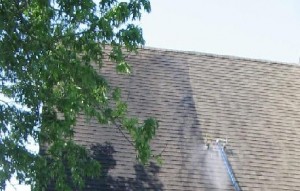
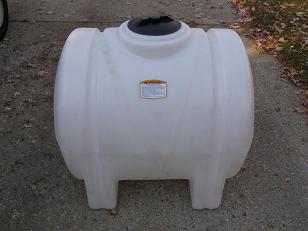
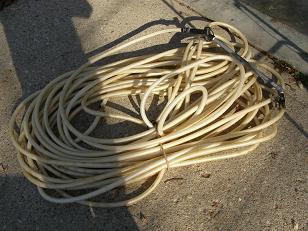
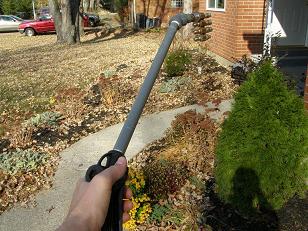
This is by far the safest and most effective way to clean a roof, but the catch is that an average one-story ranch house is going to require anywhere from 30 to 60 gallons of total mix.  That means you'd need about 15-30 gallons of typical 6% household bleach.  Typically, the pros will have the whole mix in a large poly tank on their truck or trailer, and will use a battery-powered pump to deliver the solution through a long polybraided hose up to the roof surface.  They'll usually have a bleach resistant tip on the end of the hose that evenly disperses a soft spray over the roof surface.  They'll leave the solution on the surface to let it do its thing for several minutes before rinsing the surface with water from the garden hose.  So no power washers or scrubbing should be required (the only exception could be for thick moss accumulations).  If you're doing this yourself, you'd also want to keep the whole perimeter of the home rinsed down very well during the application (preferably by a second person) as sodium hypochlorite can have a negative effect on landscaping if not properly diluted.  Be especially mindful of areas where downspouts empty into grass or other greenery.   Occasionally you might have to go over a few spots a second time, but the results should be instant!  Rinse the roof and perimeter very well, let dry, and enjoy your new-looking roof.

You can do this yourself, of course, but you'd be looking at having to purchase hundreds of dollars worth of equipment and chemicals, so why not just hire a professional that specializes in no-pressure roof cleaning?  Try to find one that utilizes the roof cleaning chemicals that I just outlined.

If you do decide to go for it yourself, BE CAREFUL.  The hazards include, but are not limited to: falling off ladders, slipping on the roof surface (which is made very slick when solution is applied), getting bleach spray in your eyes or lungs (wear eye protection and a mask), leaning a ladder against a power line, etc.  This work is not for the faint of heart.  Harnesses and support systems might be a good idea.

You can expect this type of treatment to keep the roof clean anywhere from two to six years before stains start to return, with an average of three to four years.  I've yet to come across any so-called "sealers" that actually work.  Your best bet is just to have the roof re-cleaned by a professional when the algae streaks have returned.  The zinc strips that some try to market don't work that well in my opinion.  They may be somewhat effective for the 2-3 feet of roof surface directly below the strip, but what about the rest of the roof?  The zinc is also a very expensive material.  Just have a pro clean your roof every couple years and save yourself the hassle.  If you need guidance on how to find a good contractor then read this post about roof cleaners.

January 05, 2008

Roof Cleaning Chemicals Are A Good Alternative To Power Washing

Power washing a roof is usually not a very good idea.  High pressure cleaning will often result in the loss of shingle granules, which are crucial to the health and effectiveness of your roof.  Aggressive power washing can even result in water intrusion below the shingles, and places like skylight edges are especially susceptible.  Power washing will usually remove most of the algae, but is it worth it if it removes part of your shingles in the process?

There are some roof cleaning chemicals on the market now that require the use of medium-level pressure.  This method involves the use of a power washer, but instead of a high-powered wand at the tip, it has a device which helps to disperse the water pressure through three separate nozzles.  While this method is better than using high pressure, you should be aware that each nozzle is probably still delivering somewhere between 800 and 1300 psi of water (you garden hose psi is under 100).  It is quite possible that this method will still result in the loss of some surface granules, and thus could contribute to compromising the integrity of your roof over time.  Why would you want to lose any shingle granules if you don't have to?

My advice?  Skip the fancy roof cleaning products that require pressure, if possible.  Your best bet for safe, effective roof cleaning is to utilize chemicals that will kill the algae on your roof without the need for any pressure whatsoever.  This method simply involves spraying on the chemical solution, allowing it several minutes to work, and then rinsing off the dead algae with water from your garden hose.  Think it's not possible?  Think again!  Our next post will detail exactly how this is accomplished.

January 04, 2008

Why Chemical Roof Cleaning Is Important

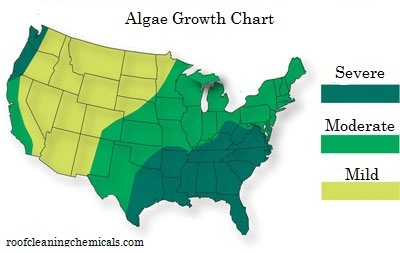
Those streaks on your roof are Gloeocapsa Magma, a type of algae that just loves hot, humid climates.  It's become more of a problem in the last several years as shingle-makers now use limestone filler in the manufacturing process, which is actually a food source for the algae.  So the algae is quite literally eating your shingles, quite possibly resulting in a shortened lifespan for your pricey roof!  Additionally, if allowed to go unchecked, the algae build-up can significantly reduce your roof's reflective properties, resulting in more strain on your air conditioner and higher energy costs.  Lastly, those black streaks are ugly, and can drastically tarnish the curb appeal of an otherwise beautiful home.  After a roof cleaning treatment, you'll be astonished by how good your roof looks, and the neighbors will probably appreciate it as well!  Roof cleaning is one of the best, most cost-effective ways to instantly beautify the look of your home and neighborhood.  The job is usually best left to a professional, primarily for safety reasons, but this blog will also explore the most effective roof cleaning chemicals available, should you have the time, inclination, and risk-tolerance to take it on yourself.

January 03, 2008

Welcome To Roof Cleaning Chemicals

Thanks for visiting our roof cleaning chemicals guide. We have taken the time to organize information that can help you to learn about different roof cleaning products, chemicals, and cleaning procedures. If you’re looking for information on a particular roof cleaning chemical, or just roof cleaning information in general, you have come to the right place.

If any of you would like more information on roof cleaning chemicals, please feel free to let us know. Thanks again for the visit and make sure to check back often to receive additional information on roof cleaning.  This is your one stop shop for all things roof cleaning.